Visual attention

Visual attention is the willful or automatic selection of certain visual information for enhanced, prioritized processing. Attention can select locations (attending to something on the left, “out of the corner of your eye” for instance), features (attending to red, because you’re trying to find your red car in a crowded parking lot), or objects (attending to faces, for instance, in an effort to find your friend in a crowd). Attention can be ‘grabbed’ exogenously by very salient stimuli, as with flashing red warning lights, or be directed endogenously in willful top-down manner, as when you choose to attend to the suspicious person on your left, even while keeping your eyes pointing straight ahead.
Visual attention is required, just like eye movements, because there is simply too much visual information around you at any given moment and your brain isn’t big enough to process it all. Thankfully, you can select and prioritize certain visual information; you come pre-programmed to devote your attention to likely important events: fast moving objects, red flashing lights, locations with loud sounds, etc. Also, thankfully too, you have a ‘manual override’ that lets you ‘tune in’ to visual information that you think is important, just like in the examples above. At any given moment what you are attending to is determined by the interplay of these automatic and willful processes.
Evidence that there’s ‘too much information’
The following examples should convince you that there is indeed too much information in the visual scene at any given moment to be fully processed.
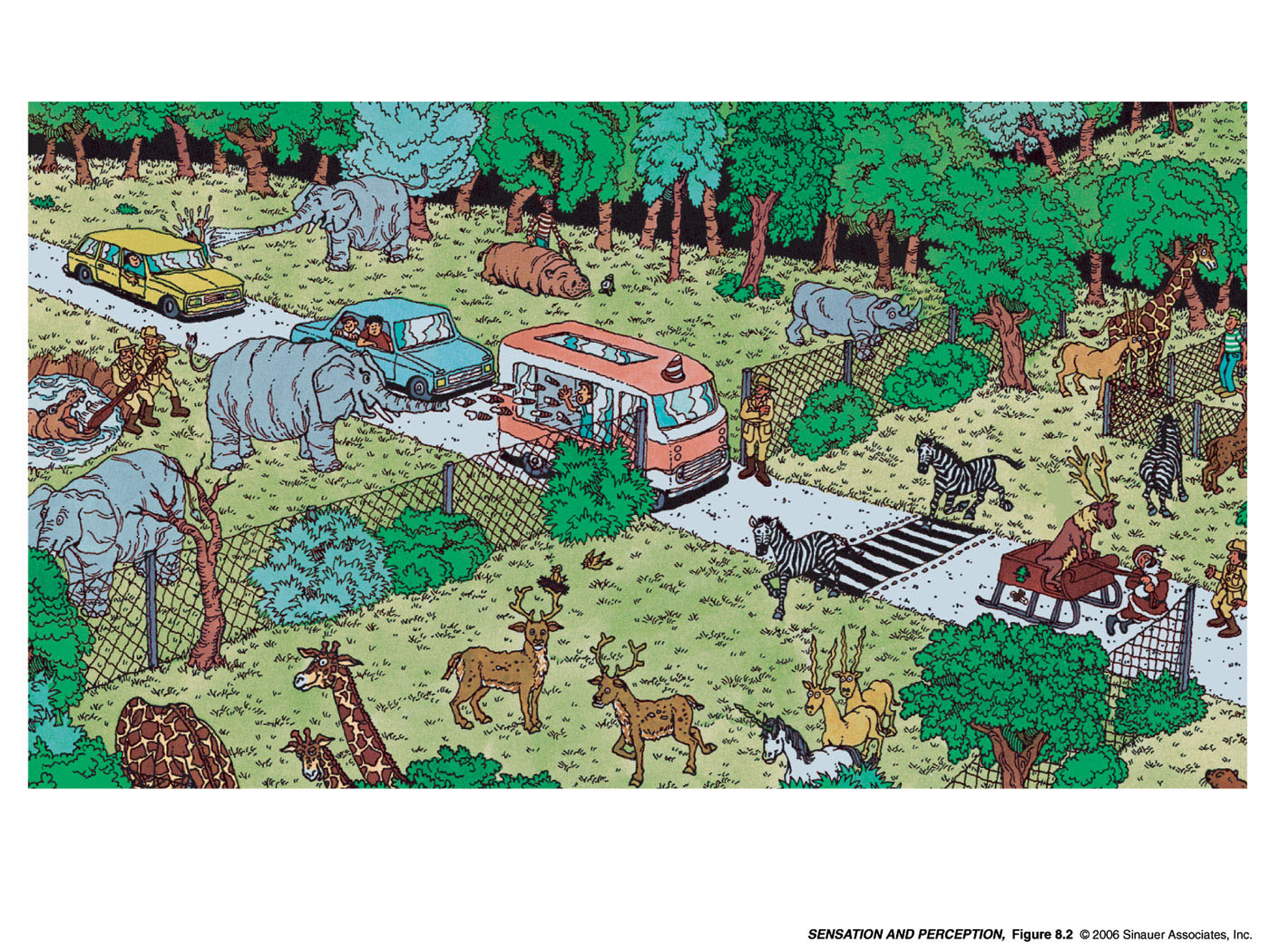
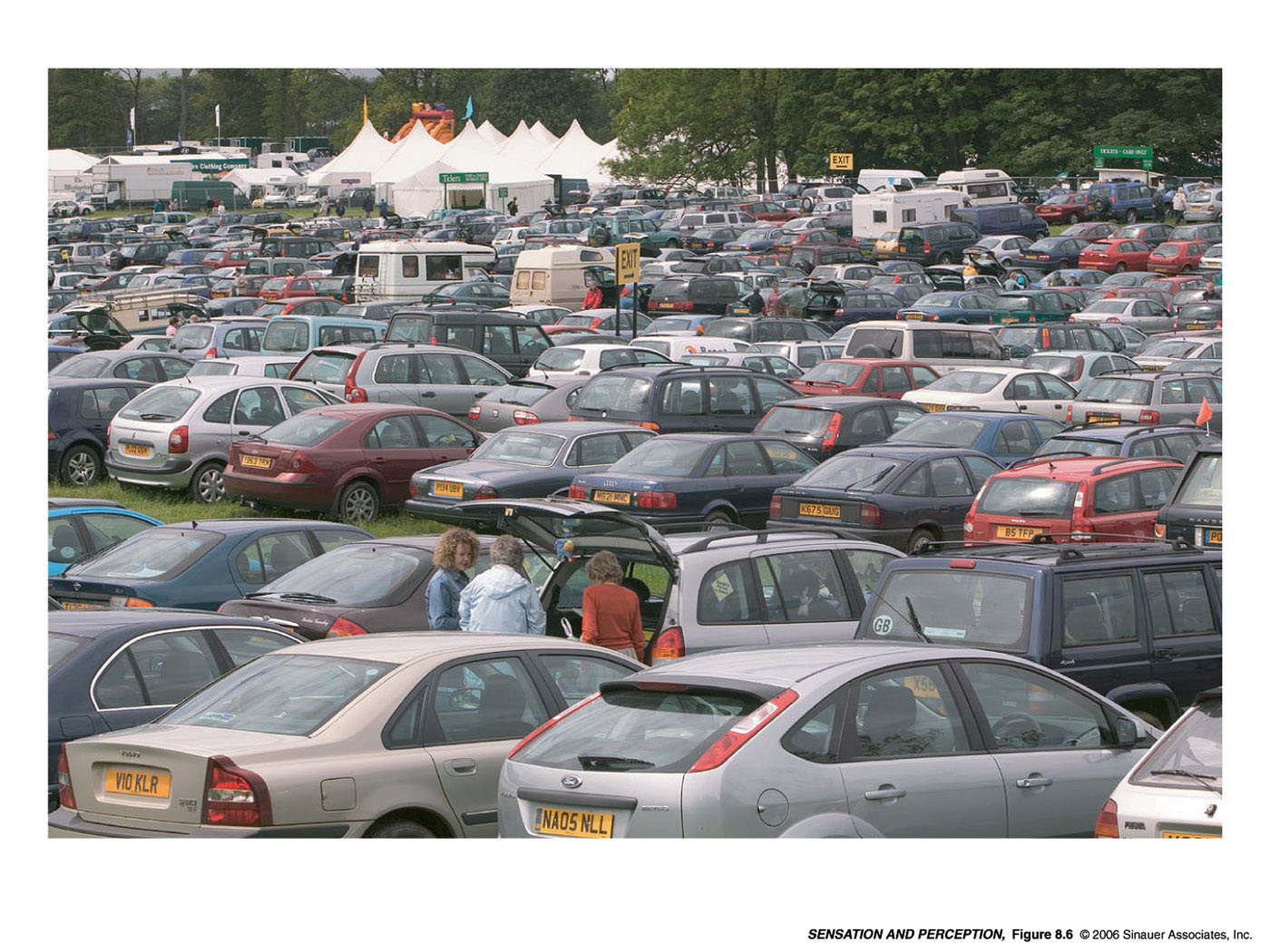
If you just have to open your eyes, and everything out there gets in and gets processed, then why is it so hard to find Waldo? In more everyday situations, maybe you’re just trying to find your red Volvo wagon in the parking lot (this is an example, by the way, of a ‘conjunctive search’ - you have to search for two things in conjunction, redness and wagon-shape):
There are other very compelling examples that I will demonstrate in class. For instance, the phenomena of change blindness (another example) show just how little information you can actually process in a scene (here’s a card trick that makes the point too). This is a consequence of the fact that there’s too much info and you don’t process everything. It doesn’t feel like you are missing much, but in fact very little of the image that falls on your retina ever gets fully processed.
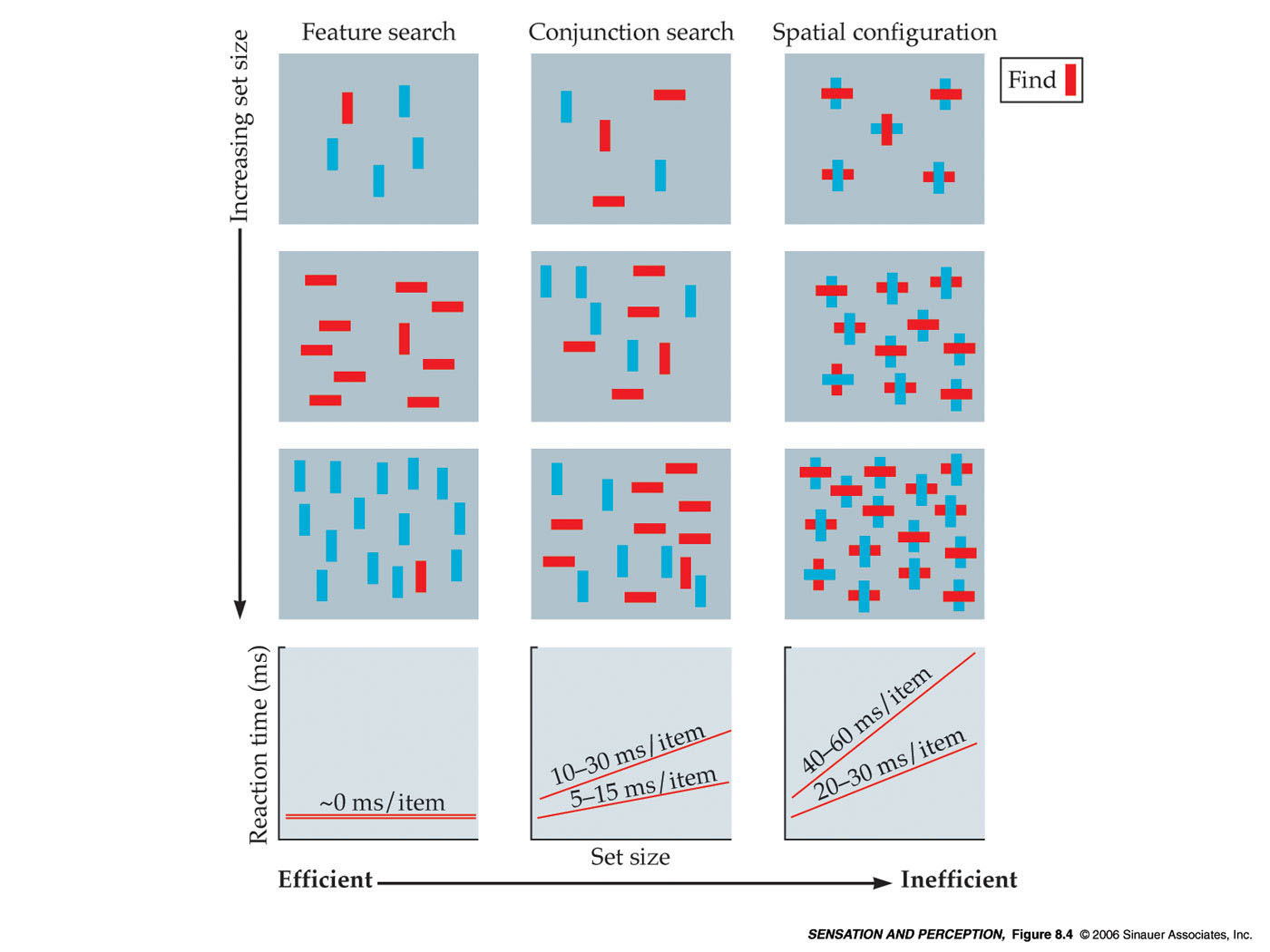
These are all examples of what we call ‘visual search’. Here is what visual search looks like in the laboratory - instead of the red volvo, or waldo, we are looking for a red vertical bar:
28. Visual attention
1:47 PM
Visual attention is the willful or automatic selection of certain visual information for enhanced, prioritized processing.
Evidence that there’s ‘attentional selection’
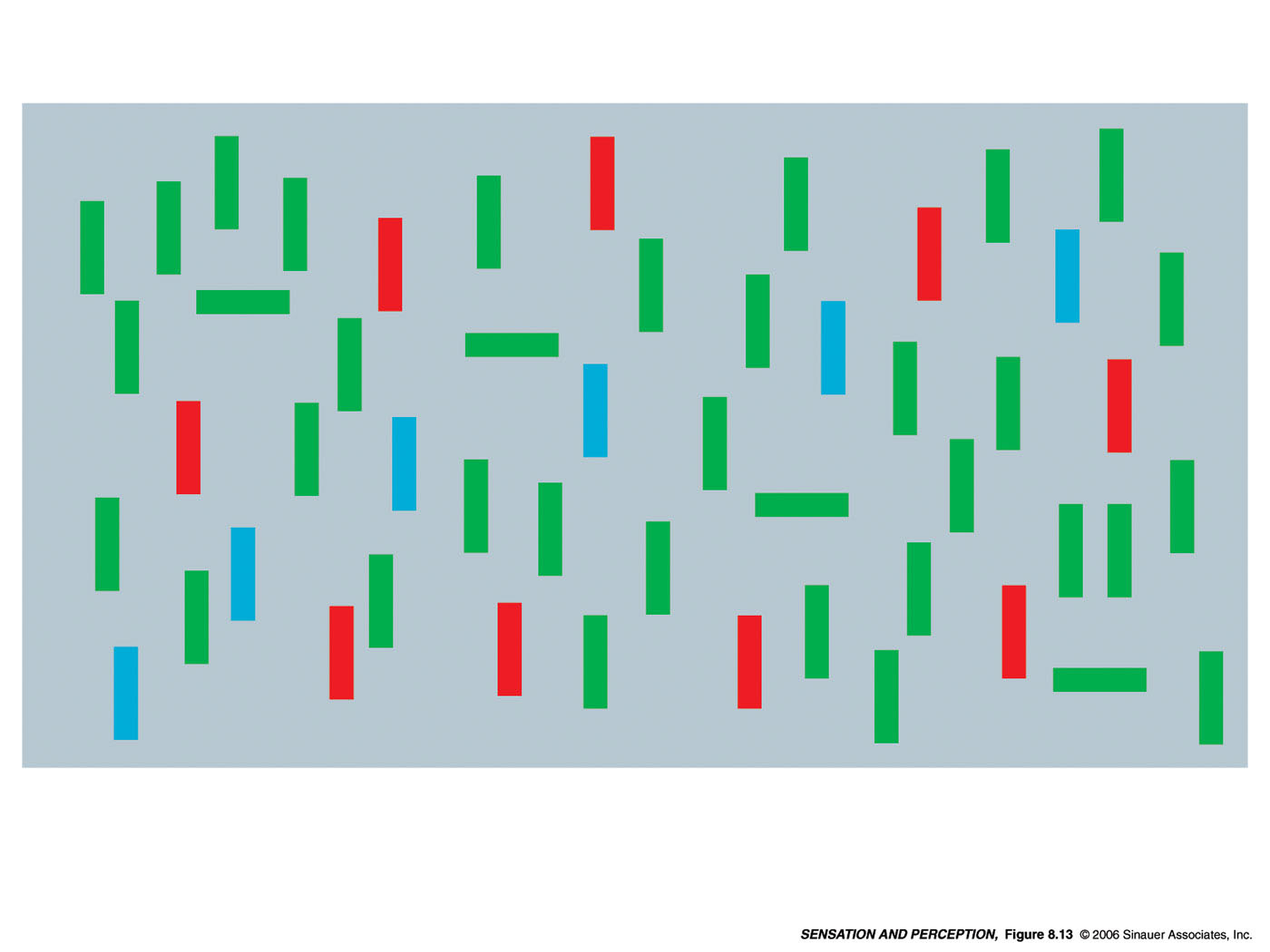
We just saw some evidence that there’s too much information in the visual scene for you to process all at once. Luckily, your visual system can prioritize what should get processed. The picture above may just look like a bunch of random colored lines. But stare at the center and try to mentally enhance the red items, that is, direct your visual attention to selectively process the red items in the scene. You might feel that they become subjectively ‘clearer’ and more ‘salient’. You may also now notice that they are arranged in a rough oval pattern. You can do the same for the blue items, noting their diagonal arrangement. These effects are subtle, but significant, evidence for attentional selection.
Multiple object tracking and tasks are good examples of attentional selection at work.
Brain imaging has shown that that, for instance as shown below, attending to pictures of houses or faces can selectively enhance the brain areas responsible for processing those objects.
Important evidence for selection comes too from clinical cases where brain lesions have created patterns of neglect, where patients ignore the left or right halves of objects. These examples show what happened when one patient was asked to put a red mark across every black line in the picture, and when another was asked to copy the picture of the house.



Let’s try selection in a more real-world setting: