Stereopsis
Stereopsis is based on a simple geometric fact: since your two eyes are in two different places in your head, they see the world from two slightly different points of view. This is, in fact, an important reason why we have two eyes in the first place. Because of this difference in viewpoint, the relative positions of parts of the scene you are looking at will different on the two retinas. The brain can use these differences, and some geometry, to make an estimate of the depth of various parts of the scene.
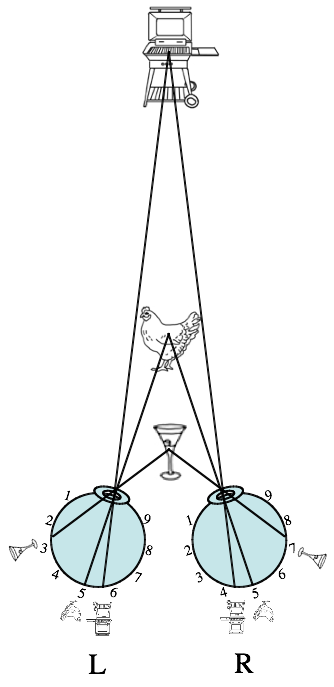
Look at the diagram on the right. One of your eyes (the left one, ‘L’) looks at the world from the left side of things, and your right eye (‘R’) from the right side of things. That means, even though you are looking at the same ‘stuff’, each eye is getting a slightly different image projected onto its retina. To convince yourself that these subtle differences exist, just open and close each of your eyes and notice that things are in slightly different positions. The differences are small, but your brain can notice them if they are above about 1/25,000th of an inch, so, well, that’s pretty good. (To make a more noticeable difference, point at something far away with your finger and do the opening and closing business).
In this diagram, the little numbers on the two retinas refer to ‘corresponding points’. Notice that if we slid one eye on top of the other and rotated them so that they lined up, these numbers mark identical positions. Now, notice that none of the objects in the image, except for the chicken that you are looking at directly, actually fall on corresponding points. In other words, the two images are different. These differences are the ‘binocular disparities’ on which stereopsis is based.
After all, this is just some quite basic geometry: ‘if a piece of the image (say corresponding to the martini) is at position 3 on my left retina and position 7 on my right retina, then, well, this can only happen if it is closer to me than the chicken I’m staring at.’ Ok, the brain says, so let’s give the observer some 3D perception of martini closer and chicken farther and grill farthest.
One last note: Notice that if instead of thinking of these two retinas here as corresponding to your two different eyes, we just think of this diagram as for one of your eyes in one location L, and then some time later, say if you are moving, in some other location R, then these different objects will sweep across your retina at different speeds (and even different directions!). (The martini has to zip all the way from location 3 to location 7, while the grill just creeps from 5.5 to 4.5). The depth cue ‘motion parallax’ is based on noticing these differences.
26. Stereopsis and Motion Parallax
1:16 PM
Stereopsis is your most precise cue to depth.