Dark & light adaptation
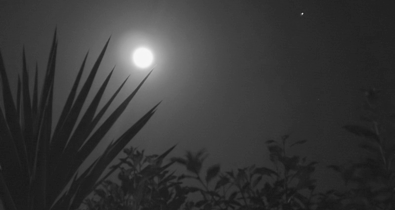
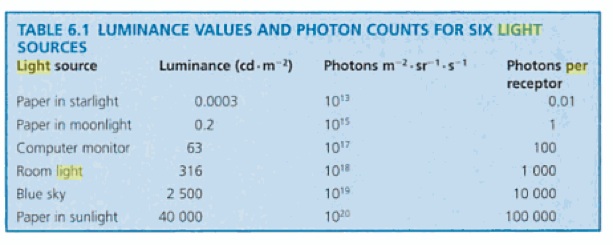
When you are in a low light environment (movie theater, dim moonlight, duct-taped closet), your visual system will adjust itself so that it can pick up small amounts of light (how small? under ideal conditions, something like 20 or so photons. And remember, 1 photon is the smallest amount of light that is possible). When you are in a bright environment, your visual system will also adjust, becoming less sensitive (how bright? about 10 trillion (not making that up) photons per second.
Overall, your visual system has an ‘operating range’ of at least 10 million (so, it can operating a a dim environment and one that is 10,000,000 times brighter). How does it adapt to these conditions?
Pupil dilation. When you first go into a dark environment your pupil opens to a diameter of about 8 mm in a matter of seconds, this lets in about 10x more light than usual. That sounds like a lot, but that hardly gets us to 10,000,000x.
Duplex retina (we’ve discussed this previously).
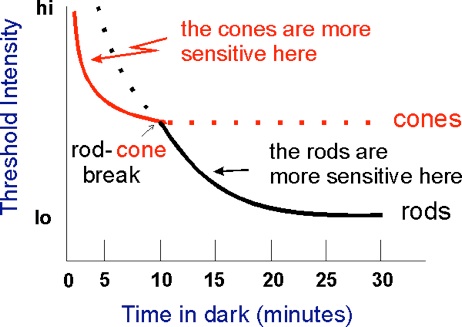
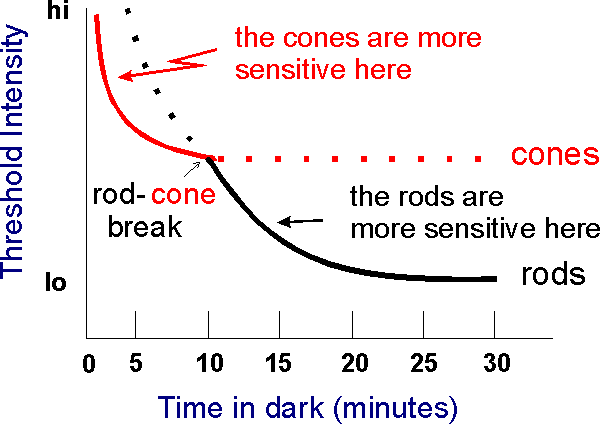
Cone recovery. Your cones replenish their photopigment, hoping to pick up lower amounts of light. But your cones aren’t good at all for very dim environments anyway, so this doesn’t buy you much. This recovery happens over a period of about 5 minutes.
Rod recovery. Your rods replenish their photopigment, getting nice and juicy. Fully juicy, rods support most of your dim-light vision. This recovery process, though it starts immediately, takes about 40 minutes to complete.
16. Dark and light Adaptation
1:26 PM
Dark adaptation refers to your visual systems’ ability to get more sensitive as it spends time in the dark.
IMAGE CREDITS